Discover the Geological Net Zero Pact
Bringing Carbon Cycle Stakeholders Together to Tackle Climate Change
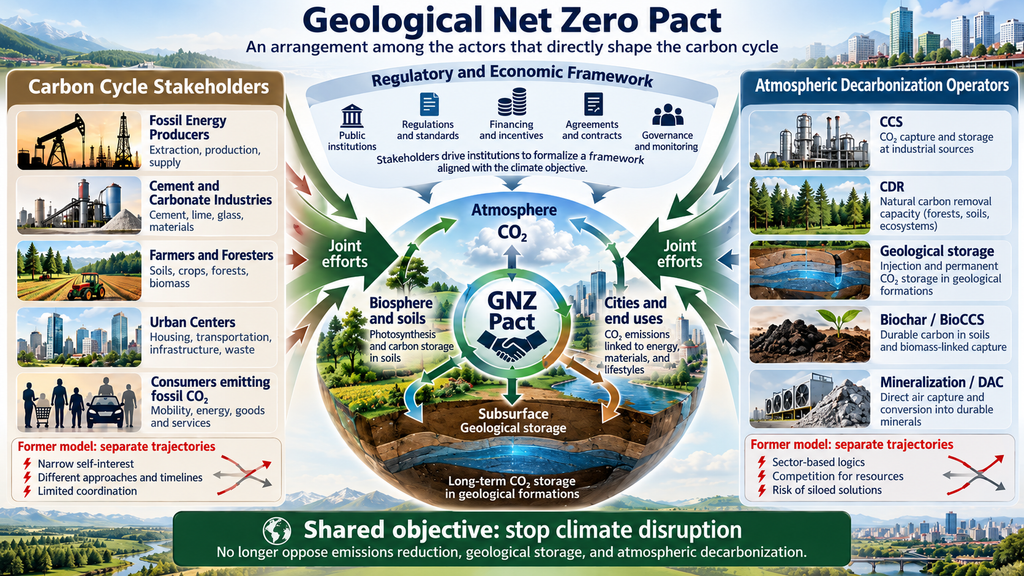
Why a GNZ Pact?
Climate change results from a growing imbalance in the carbon cycle, driven in particular by the massive transfer of carbon from geological reservoirs into the atmosphere, oceans, and biosphere.
Today’s climate policies pursue two approaches that are often implemented separately: reducing greenhouse gas emissions and removing CO₂ already accumulated in the atmosphere.
Both approaches are essential, but their implementation remains fragmented across economic sectors, countries, and institutions.
The Geological Net Zero (GNZ) Pact, founded on the GNZ Principle, proposes bringing carbon cycle stakeholders together around a shared responsibility: halting the imbalance caused by the depletion of geological carbon stocks and helping restore the long-term balance of the climate system.
Who is the Pact for?
The Pact addresses stakeholders involved in carbon flows or in shaping the frameworks and financing that govern them:
Fossil Fuel Producers and Actors Across Fossil Carbon Value Chains
Oil and gas companies, coal producers, refiners, transport operators, traders, distributors, and energy suppliers, whose activities span the extraction of fossil carbon through to its delivery to end users.
States and International Bodies
Governments and international bodies that establish the cooperation, regulatory and financing frameworks needed for defossilization, durable sequestration and an equitable allocation of responsibilities.
Industries Using Geological Carbon
Cement and lime producers and other industries processing carbonates, as well as industries consuming fossil-based raw materials.
Stakeholders in Biological Carbon Cycles
Farmers, foresters, and biomass-based businesses that can help replace fossil resources with renewable alternatives, strengthen biological carbon sinks, and develop long-term carbon sequestration pathways.
Territories and Consumers
Cities, local and regional authorities, businesses, and end consumers whose decisions shape resource demand and associated emissions.
Carbon Sequestration and Removal Operators
Operators involved in carbon capture and geological storage (CCS), carbon dioxide removal (CDR), mineralization, and other long-term carbon storage solutions.
From Competing Pathways to Joint Action
The climate transition still too often pits fossil fuel producers against consumers, advocates of emissions reductions against proponents of carbon removal, and energy-producing countries against energy-importing countries.
The Pact seeks to move beyond these divisions.
Rather than merely combining independent commitments, the aim is to build an agreement among stakeholders, based on clearly identified responsibilities, complementary contributions, and reciprocal commitments to defossilization, sequestration, and financing.
Geological carbon producers, consumers, sequestration operators, and public institutions thus become partners in a shared transformation.
Proposed Commitments
1. Establish Responsibility for Geological Carbon Use
Progressively link the extraction and introduction of geological carbon into economic value chains to verifiable geological sequestration obligations, while encouraging the reduction and substitution of fossil resources and preventing double counting.
Organize the transfer of responsibility along the value chain, from producer to consumer, while distinguishing the transfer of responsibility from its actual fulfillment through verified geological sequestration.
2. Accelerate Defossilization
Progressively reduce fossil carbon extraction and use through greater energy and material efficiency, electrification, the development of renewable resources, and the substitution of fossil-based raw materials with alternatives, including sustainably sourced biogenic materials.
Support the transformation of extractive industries toward new energy, industrial, and carbon sequestration activities, drawing on their expertise, infrastructure, and geological resources.
Defossilization reduces new fossil carbon flows and the associated sequestration obligations.
3. Scale Up Long-Term Carbon Sequestration
Develop carbon sequestration capacity, alongside solutions for removing and durably storing atmospheric carbon: carbon capture and storage, mineralization, bioCCS, biochar and other processes providing sufficient guarantees of permanence and net carbon balance.
Different forms of carbon storage must be assessed according to their specific characteristics and cannot automatically be considered equivalent.
Clearly distinguish, in carbon accounting, storage that fulfills obligations associated with current extraction from storage that contributes to reducing the historical excess.
Long-term carbon sequestration complements defossilization: it addresses residual geological carbon flows while helping, through CDR, to reduce the historical carbon imbalance.
4. Mobilize Financing
Mobilize contributions from fossil carbon value chains to finance defossilization, industrial transformation, and long-term carbon sequestration.
These resources could notably support sovereign defossilization funds in fossil fuel-producing countries, as well as contractual financing mechanisms among producers, consumers, and sequestration operators.
They would help support infrastructure, long-term investment, and the economic transition of the territories concerned.
Financing must simultaneously support the reduction of fossil carbon use and the development of carbon sequestration capacity.
5. Build a Common Institutional Framework
Engage governments and international organizations in the progressive development of a legal, regulatory, and accounting framework grounded in responsibility for geological carbon.
Public authorities must ensure transparency across value chains, the reliability of verification mechanisms, access to the necessary infrastructure, and conditions that enable consumers to make informed choices.
The responsibilities and contributions of each stakeholder must reflect their capacity to act, access to information, and economic and social circumstances.
GNZ and CDR: Acting Together, Without Delay
The Pact combines reduced fossil resource extraction with the development of durable sequestration. CDR can contribute to GNZ balance when it delivers geological storage meeting the required criteria; it must also contribute to reducing the historical excess of carbon.
These efforts must proceed simultaneously, mobilizing complementary stakeholders, infrastructure and financing.
A Pact Open to International Cooperation
The GNZ Pact is neither an existing treaty nor an established regulatory instrument. It is a proposal for cooperation to be developed among economic, scientific, territorial, and institutional stakeholders.
Its purpose is to foster reciprocal commitments, industrial demonstration projects, financing mechanisms, and, ultimately, a shared international framework.
First Steps Toward Practical Implementation
The GNZ Pact can be tested at different scales without waiting for an international agreement to be adopted.
Groups of stakeholders belonging to the same geological carbon value chain, or to a particular segment of that chain, can voluntarily define their respective responsibilities, defossilization and sequestration commitments, and financing and verification mechanisms.
These demonstration projects will help assess the proposed methods, measure their results, and prepare for their wider application across other industries and territories.
Our Call to Action
Let every stakeholder in the carbon cycle contribute, according to their responsibilities and capabilities, to a common goal: ending the geological carbon imbalance and restoring long-term climate balance.
GNZ and CDR, together, starting now.
Contribute to the GNZ Pact
Would you like to help develop the Pact, propose a collaboration or participate in a demonstration project? We invite economic, scientific, local and regional, and institutional stakeholders to share their proposals.
Contact us to discuss your contribution.
Reference Article in Preparation
A reference article on the Geological Net Zero Pact, its underlying principles, proposed governance framework, and implementation pathways is currently in preparation.